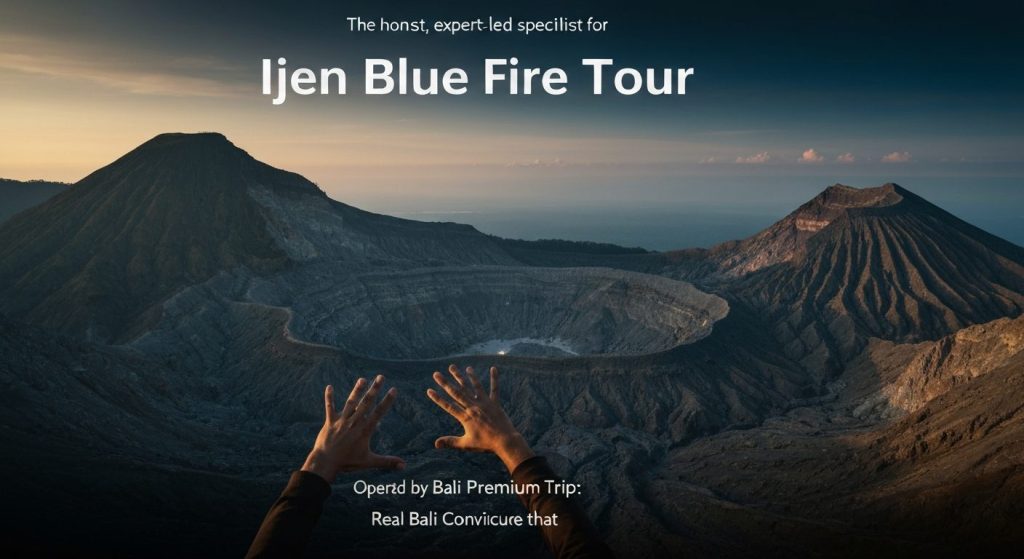
An Ijen blue fire tour is a guided night trek to Kawah Ijen's crater rim and acidic lake to see blue sulfuric flames before sunrise. From Banyuwangi it runs ~8-10 hours and starts from about IDR 950,000 / USD 60 per person; from Bali it runs ~20-24 hours from roughly IDR 1,900,000 / USD 120. Prices indicative, June 2026. Arranged by Bali Premium Trip.
An ijen blue fire tour is a guided night hike to Kawah Ijen’s crater to see its electric-blue sulfur flames before sunrise, then watch dawn over the turquoise acid lake. On this page I’ll lay out exactly how the midnight blue fire trek works, what it demands at 2am, and how Bali Premium Trip and our Banyuwangi guides actually run it in real conditions.
I’m Daniel, Ijen Trek & Volcano Editor at Ijen Blue Fire. I’ve walked this route in the dark more times than I can count. My job is to pressure‑test every itinerary against the real climb: the steep gravel, the sulphur smoke, the park rules, and the way timing actually plays out on a good — and a bad — night.
—
## What is the Ijen blue fire and how do you actually see it?
The blue fire at Kawah Ijen is a sulphuric blue flame that appears when volcanic sulphur gas ignites on contact with oxygen and burns at very high temperatures. At night, this shows as rivers and patches of electric-blue light flowing down the rock near the sulphur mining area.
A few key points, stated plainly:
– You can only see the blue fire in the dark.
– You need to be close to the vents, down inside the crater, to see it well.
– Access depends on volcanic gas levels, wind direction and the park rangers’ calls on the night. It is never guaranteed.
The classic ijen blue fire night hike is built around this reality. You start around midnight, hike ~3 km up to the rim, then descend ~250–300 vertical metres into the crater when (and only when) conditions and ranger instructions allow.
Our role as an ijen blue fire tour operator is to plan and coordinate everything around that narrow window: timing, gas masks, permits, local licensed guides and transport from Bali or Banyuwangi.
—
## Why go with a specialist blue fire trek operator?
You can buy a last‑minute ticket at the gate and hope someone hands you a mask. People do that every night. Some are fine. Some make it 200 metres up the trail and turn back.
A focused kawah ijen blue fire tour is different because:
– The entire itinerary is built around the blue fire window, not just “sunrise at Ijen”.
– Your guide is Banyuwangi‑based, licensed, and used to working at 2am in shifting sulphur clouds.
– Gas masks and basic safety gear are arranged in advance — not rented in a rush at the parking lot.
– Transport, ferry and timings from Bali are matched to the midnight entry, not to a daytime tourist schedule.
Bali Premium Trip is a Bali concierge that plans and runs these tours using its own team on the Bali side plus vetted, licensed guides who work at Ijen full‑time. We don’t own the mining concession or the national park license, and on some dates we use partner operators. Because Ijen Blue Fire is operated by Bali Premium Trip, you book directly with our own reservations team at transparent, published rates — with no third-party markup or hidden commission.
—
## The midnight blue fire itinerary, step by step
This is the standard private ijen midnight blue fire trek that we actually run and regularly re‑test on the ground. Minor times may shift with season and traffic, but the sequence is consistent.
### Typical tour duration
– Total door‑to‑door time from Bali (south Bali or Ubud): ~20–24 hours round‑trip
– Total door‑to‑door time from Banyuwangi: ~8–10 hours round‑trip
– Active hiking time: 3–5 hours, depending on pace and crater access
### From Bali: example timeline
This is how a private ijen blue fire tour from Bali usually unfolds:
**Day 1 (evening)**
– 18:00–20:00 – Pick‑up from your hotel in South Bali, Ubud or North Bali
– 22:30–23:30 – Arrive at Gilimanuk port, board public ferry to Java (approx. 1 hour crossing, 30–60 minutes buffer)
**Day 2 (night to morning)**
– 00:30–01:00 – Arrive at Banyuwangi side, transfer to Paltuding Ijen base (approx. 1.5–2 hours by car, depending on road conditions)
– 01:30–02:00 – Reach Paltuding parking area (±1,850 m). Meet Banyuwangi licensed guide, final briefing, gear check, hand out gas masks and headlamps as arranged.
– 02:00–02:30 – Start the ijen blue fire night trek on the main trail.
**The climb to the rim**
– Distance: ~3 km from Paltuding to the main crater rim view point
– Elevation gain: roughly 500–550 m
– Typical time: 1.5–2 hours at a steady, non‑rushed pace
The first 1.5 km is the hardest: a sustained, sometimes loose gradient where many people realise they’ve underestimated the climb. There are short, flatter sections to catch your breath, and several unofficial rest kiosks where local sellers offer hot tea or instant noodles.
Your guide will manage the pace so you don’t burn out before the rim. The goal is to reach the rim with enough time in the dark to attempt the descent to the blue fire zone, subject to ranger approval.
**Descent into the crater for blue fire**
– 03:30–04:30 – Typical window for descent and blue fire views
– Vertical drop from rim to mining area: ~250–300 m
– Descent route: steep gravel, rock steps, some loose sections; often crowded
Here, the realities:
– Gas masks on. You must wear your ijen night hike gas mask properly **before** entering the thicker sulphur fumes.
– Your guide will test wind direction and visibility and follow park ranger instructions. Sometimes the crater is closed without warning.
– If allowed, you descend in single file. Hands may be needed for balance on steeper sections.
At the base, the blue fire glows from the sulphur vents. You are very close to working miners, in their workplace, and your guide will position you where it is safe and permitted to stand without blocking their path or getting too close to the vents.
Time in the crater is limited. Typically 15–30 minutes of effective viewing and photos, less if gas levels rise.
**Back to the rim and sunrise over the lake**
– 04:30–05:00 – Start climbing back up to the rim before the sky brightens
– 05:00–06:00 – Watch first light and sunrise over the turquoise acid lake, if weather and gas visibility cooperate
As daylight returns, you’ll see the wider scene: the huge crater, the milky‑turquoise surface of the lake, and the surrounding mountains. This is often when people realise how far down they went in the dark.
**Descent to Paltuding and return**
– 06:00–07:30 – Hike back down the main trail to Paltuding
– 07:30–08:30 – Simple breakfast stop near the parking area (warung or pre‑arranged box breakfast)
– 09:00–10:30 – Drive back to Ketapang ferry port
– 11:00–12:00 – Ferry back to Bali, then drive to your hotel (typically arriving mid‑afternoon)
From Banyuwangi (hotel pick‑up), simply remove the ferry legs. Most Banyuwangi departures leave hotels around 00:00–01:00.
—
## Difficulty: who is the Ijen blue fire night hike for?
Kawah Ijen is not a technical climb, but it is not a casual walk either. The ijen blue fire night hike feels significantly harder than a flat 6 km walk at sea level.
### Trail and fitness realities
– **Trail type:** Wide dirt and gravel track, some concrete sections, then a rocky path into the crater. No ropes, but some steep parts.
– **Grade:** Long uphill at 20–30% in sections; the first half of the climb can feel unrelenting.
– **Altitude:** Rim around 2,350–2,400 m. Many people feel slightly short of breath compared with sea level.
– **Temperature:** Typically 5–15°C at the rim before sunrise; wind can make it feel colder.
From my experience shadowing dozens of groups:
– If you can comfortably walk 6–8 km on hilly terrain in 2–3 hours, you should manage the rim hike with enough breaks.
– The descent into the crater is more about confidence with steep, loose ground and tolerance to sulphur fumes than pure cardio fitness.
We do **not** recommend the blue fire descent for:
– People with serious respiratory issues (asthma, chronic bronchitis, COPD)
– Pregnant travellers
– Young children; most licensed guides prefer a minimum age of 10–12 for crater descent, and sometimes older, depending on the child and conditions
You can still hike to the rim and enjoy the sunrise lake view without going into the crater. Many people choose this on the night, and it’s a valid choice.
—
## Safety, gas masks and park rules
### Gas masks: what we actually use
A proper ijen blue fire tour with gas mask included should provide full‑face or half‑face respirators fitted with appropriate filters (usually P‑series or multi‑gas cartridges suited to sulphur dioxide exposure). Simple paper or cloth masks are **not** enough in heavy sulphur gas.
On our tours:
– We arrange a gas mask for each client through our Banyuwangi partners.
– Masks are checked for basic fit before the descent.
– Guides carry spare masks in case of strap failures or other issues.
Still, a gas mask is not magic. It reduces inhalation of sulphur dioxide but doesn’t eliminate it. You will smell sulphur, and your eyes may still sting. Your guide will move you if gas intensifies.
### Park authority and mining concession
Kawah Ijen is managed as a nature reserve / national park area with an active sulphur mining concession inside the crater. This means:
– Park rangers can close the crater or entire mountain at any time if gas is too strong, seismic activity increases, or weather turns hazardous.
– The sulphur mining area is a workplace. Miners have priority, and access around the vents can be restricted.
– No operator, including us, can override these decisions.
We plan your kawah ijen blue fire tour to **attempt** the crater descent, but we do not guarantee access on any given night.
### Weather and closures
Typical closure reasons:
– Sudden changes in wind send sulphur directly up the descent route.
– Heavy rain makes the trail dangerously slippery, especially inside the crater.
– Volcanic gas levels exceed safe thresholds as monitored by authorities.
Sometimes only the crater is closed but the rim is open. In this case, you still do the ijen midnight blue fire trek to the rim and watch sunrise, but you’ll view the blue fire only faintly (if at all) from above, and often you won’t see it clearly.
We’ll always tell you this in advance if we know, and your guide will re‑brief you at Paltuding on the current status.
—
## What’s included in a Bali Premium Trip Ijen blue fire tour
Because Bali Premium Trip acts as a Bali‑side concierge and coordinator, your inclusions differ slightly depending on starting point (Bali vs Banyuwangi) and private vs open group.
Below is a typical structure for a **private ijen blue fire tour**:
### Core inclusions
– **Licensed Banyuwangi guide** who regularly works on the Ijen night shift
– **Ijen blue fire tour with gas mask included** for each participant
– **Headlamp** or flashlight (we recommend you still bring your own backup)
– **Park entry tickets and basic permits**, arranged in advance where possible
– **Transport from Bali or Banyuwangi** in a private vehicle (driver, fuel, parking)
– **Ferry tickets** Bali–Java–Bali on public ferries (from Bali departure)
– **Simple breakfast** after the hike (local warung or boxed)
– **Bottled water** and sometimes hot drink at Paltuding (depends on package)
### Common exclusions
– Meals outside the specified breakfast (dinner before the hike, extra snacks)
– Tips for guide, driver and miners (voluntary but appreciated)
– Personal insurance (we strongly recommend you have travel insurance that covers hiking up to ~2,500 m and volcanic areas)
– Warm clothing, gloves and proper hiking shoes — you need to bring or rent these
If a partner operator is involved for part of the service (for example, a specialist Banyuwangi guiding team that we trust), we’ll tell you. Because Ijen Blue Fire is operated by Bali Premium Trip, you book directly with our own reservations team at transparent, published rates — with no third-party markup or hidden commission.
—
## Private vs shared: which Ijen blue fire night trek style suits you?
We arrange both private trips and help place travellers in vetted open groups when that makes more sense for budget. The experience on the trail can feel quite different.
### Comparison: private vs open-group blue fire trek
| Factor | Private Ijen blue fire tour | Open/shared group tour |
|---|---|---|
| Group size | Just your party (often 2–6 people) | Typically 6–12 people per guide |
| Departure time | Flexible within safe window; can adjust for your fitness and pace | Fixed to group schedule; less flexibility if you are slower/faster |
| Pace on trail | Matched to you; more rest stops if needed | Set for average fitness; slower walkers may feel rushed |
| Crater descent | Guide can decide per person; some go down, others stay at rim | Usually one decision for most of the group at once |
| Price per person | Higher, but better value for 3–6 people sharing | Lower for solo or 2 people willing to join others |
| Photography time | Easier to find your own spot; more guide help with angles | More competition at viewpoints; less one‑on‑one time |
If you’re a couple or small group who care about safety margins, pacing and having options on the night, a private ijen blue fire tour is usually the better fit. Solo travellers on a tighter budget often prefer an open‑group kawah ijen blue fire tour instead.
—
## Prices and starting points: Bali vs Banyuwangi
Exact pricing shifts with season, fuel costs, ferry adjustment and group size. Here’s what we actually see on the ground as **indicative ranges**, last verified June 2026.
### From Bali (South Bali / Ubud / North Bali)
A private ijen blue fire tour from Bali with gas mask included, ferry, private car, licensed guide and basic breakfast typically falls in these ranges:
– **2 travellers private:** around US$190–260 per person
– **3–6 travellers private:** around US$150–220 per person
– **Open-group from Bali (shared van + group guide):** around US$120–170 per person
This is for a long, 20–24‑hour door‑to‑door run. There is a real fatigue trade‑off: you save time by not overnighting in Banyuwangi, but you also compress a lot of driving and hiking into one cycle.
### From Banyuwangi (hotel pick‑up)
If you are already on the Java side, or happy to get there yourself by bus/train/ferry, an Ijen blue fire night trek from Banyuwangi is shorter and usually cheaper:
– **Private from Banyuwangi:** around US$90–150 per person for 2 travellers; lower per person if 3–6
– **Open-group from Banyuwangi:** around US$60–100 per person
These prices usually include hotel pick‑up in central Banyuwangi, transport to Paltuding, licensed guide, gas mask, park entry and basic breakfast.
For an exact quote based on your dates, starting point, and group size, you can plan your trip with our team via email or WhatsApp. We’ll lay out both private and group options side by side so you can pick the trade‑off you actually want.
—
## What to pack and wear for a midnight blue fire trek
You do not need technical alpine gear, but a few specific items make a big difference at 2am on a cold, windy rim.
### Clothing
– **Base layer:** breathable T‑shirt or light thermal top
– **Mid‑layer:** fleece or light down jacket
– **Outer layer:** windproof shell or rain jacket (essential if rain threatens)
– **Bottoms:** long hiking pants or leggings; jeans are not ideal when wet
– **Hat and gloves:** light beanie and gloves for the pre‑dawn chill
Temperatures can feel very cold when you are standing still at the rim in wet wind. On the climb, you’ll warm up quickly, so think layers you can open or remove.
### Footwear
– Closed‑toe shoes with good grip: trail runners or light hiking boots
– Avoid thin‑soled sneakers, sandals or flip‑flops. You’ll appreciate real tread on the loose descent.
### Gear
– Small daypack (15–25 L) for water, layers and camera
– 1–1.5 L of water per person
– Snacks: nuts, energy bars, simple carbs; you’re hiking on short sleep
– Headlamp with fresh batteries (we often supply one, but bring a backup if you have it)
– Personal medications (especially inhalers, if prescribed)
– Simple dust mask or buff for the upper trail. Your main gas mask is for the sulphur zone; a light mask helps with dust earlier on.
Your guide will carry their own safety kit, but if you have a small first aid pouch (blister plasters, painkillers, etc.), it doesn’t hurt to bring it.
—
## Choosing the right Ijen blue fire tour operator
There are many ways to book this trip: local agents in Bali, Banyuwangi guesthouses, online marketplaces and specialist planners like us. The labels can be confusing.
Here’s a straightforward way to compare:
- Licensed guide
- Ask directly: will your guide be a locally licensed Ijen guide from Banyuwangi, and is their name known in advance? Avoid setups where the driver “finds someone” at the gate.
- Gas mask quality
- Clarify: is a proper respirator included in the ijen sulfuric blue flame tour, and what type? Cloth masks and surgical masks do not count.
- Crater descent policy
- Some operators never go into the crater; some always push for it. We only descend if park rules and conditions allow and if you personally feel comfortable. Your individual call matters.
- Group size
- Ask for the typical maximum group size per guide. More than 10–12 people per guide makes it hard to manage safety in sulphur conditions.
- Transparency on partners
- If an operator uses local partners for part of the trip (guides, vehicles), they should say so plainly. We do — and Because Ijen Blue Fire is operated by Bali Premium Trip, you book directly with our own reservations team at transparent, published rates — with no third-party markup or hidden commission.
Bali Premium Trip’s role is to coordinate all of this for you across islands: we match your Bali schedule to ferry crossings, line up a driver who knows the timing, and assign a Banyuwangi guide who regularly works blue‑fire nights, not just daytime hikers.
—
## Bali vs Banyuwangi: which start makes more sense?
Both work; the trade‑offs are clear once you put them side by side.
### From Bali
**Pros:**
– No need to change hotels; start and end at your Bali base
– Maximum efficiency if you’re short on days
– Bali Premium Trip can line this up with your wider Bali plans easily
**Cons:**
– Very long day/overnight, often 20–24 hours door‑to‑door
– More time in vehicles and ferries relative to hiking time
– Slightly higher cost per person due to distance and ferry
### From Banyuwangi
**Pros:**
– Shorter, 8–10 hour door‑to‑door experience
– More rest before and after the hike
– Lower ijen blue fire tour price range per person
– Easy to pair with other East Java visits (Baluran, Meru Betiri, Bromo on a longer route)
**Cons:**
– You need to factor in getting to Banyuwangi (ferry, bus, train or domestic flight)
– One extra hotel move compared with staying in Bali the whole time
If you’re the sort of traveller who values sleep and slower days, I generally recommend at least one night in Banyuwangi. If you only have a handful of nights in Indonesia and want to add the blue fire as a one‑night push from Bali, that’s feasible; just go in with eyes open about fatigue.
If you want help weighing these options against your dates and flights, you can plan your trip with us — quick WhatsApp chats are often enough to lock in the right version.
—
## Who should skip the crater — and still go to Ijen
Ijen is not an “all or nothing” volcano. You can make smart decisions on the night:
– Hike to the rim only and watch sunrise, skipping the steep descent into sulphur.
– Let some of your party go into the crater while others stay at the rim with a second guide (possible on private tours).
– Decide at Paltuding based on how you feel — tired, sniffly, anxious — and simply walk to the first viewpoint.
From experience, these people often enjoy the trip most by staying at the rim:
– Anyone who already feels short of breath on the lower slope
– Travellers sensitive to strong smells or who get anxious in crowds and tight paths
– Photographers who prefer wide lake views over close‑up blue fire shots
The key is not to let “I must see the blue fire from 10 metres away” override your honest reading of conditions and your own body. The mountain will be here next year too.
—
## How to see Ijen blue fire responsibly
To sum up the practical side of how to see Ijen blue fire:
1. **Aim for a clear, dry‑season window** if you can (roughly May–October is usually drier, but weather shifts from year to year).
2. **Commit to the midnight start.** There’s no way around this; the flames need darkness.
3. **Use a licensed Banyuwangi guide** who regularly works the ijen blue fire night hike, not only daytime trips.
4. **Wear proper clothing and shoes,** and accept that you might still get cold, wet or dusty.
5. **Expect that the crater may be closed** or that visibility may be poor. Enjoy what the mountain does give you that night: the climb, the dawn, the lake, the wider volcanic landscape.
If you want a candid, safety‑first plan for either a private ijen blue fire tour or a vetted group option, you can plan your trip with our Bali Premium Trip team. We coordinate via email and WhatsApp and will lay out real options — including telling you if a different night or route might suit you better.
—
## FAQs
How long does the Ijen blue fire tour take door-to-door?
From Bali, expect roughly 20–24 hours door‑to‑door including driving, ferries, and the hike. From Banyuwangi, the trip is shorter, usually 8–10 hours from hotel pick‑up to drop‑off.
Is the Ijen blue fire trek safe?
It is as safe as an active volcano with sulphur gas can reasonably be, provided you go with a licensed guide, use a proper gas mask, and follow park rules. The main risks are slips on steep ground, breathing issues in sulphur clouds, and sudden weather or gas changes that can lead to partial or full closures. No operator can remove those risks; they can only manage them.
Can you guarantee I will see the blue fire?
No. No one can honestly guarantee this. The blue fire is usually active, but access depends on gas levels, wind, park decisions and crowd conditions. Some nights you can go into the crater and see it close; other nights you may only glimpse it faintly from the rim or not at all.
Do I really need a gas mask for the Ijen night hike?
For the crater descent and blue fire zone, yes. Sulphur dioxide fumes are strong there and can be dangerous in high concentrations. A proper respirator‑type gas mask is strongly recommended and should be included in a serious ijen sulfuric blue flame tour. On the upper trail and rim, many people are fine with just a light mask or buff.
What is the best time of year for an Ijen midnight blue fire trek?
Drier months, roughly May to October, tend to have clearer skies and less mud, which helps for both the hike and sunrise views. That said, conditions change every year, and the volcano can close in any month due to gas or seismic activity. Treat “best time” as a probability, not a promise.