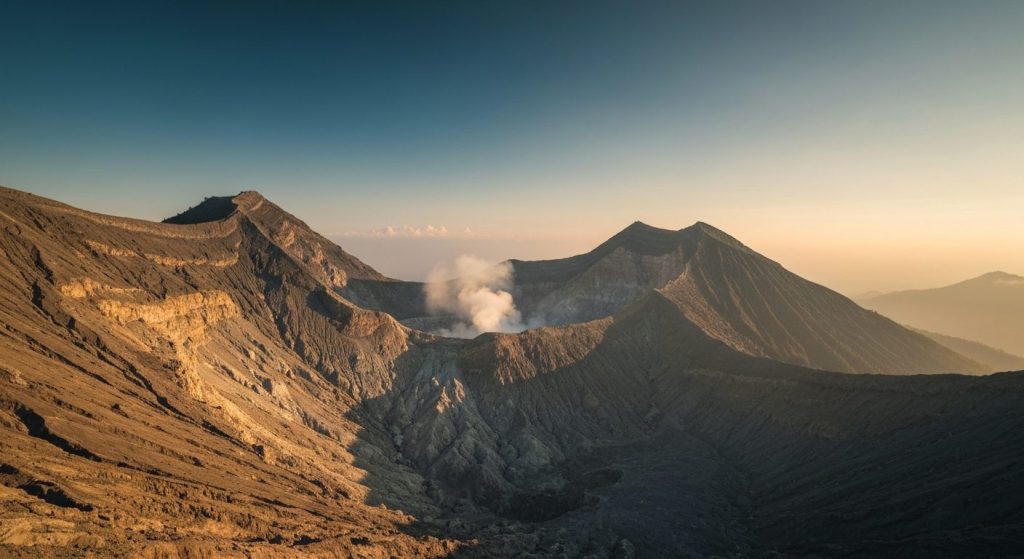
A kawah ijen crater tour is a guided visit to the active Ijen volcano in East Java focused on the turquoise crater lake, sunrise from the rim, and the daylight crater-rim walk. It’s the calmer, scenery-led alternative to the midnight blue-fire descent, with the same 2 am wakeup but a very different feel on the mountain.
Kawah Ijen crater tour: what it actually is
By “Kawah Ijen crater tour” here, I mean a night-to-morning hike that:
– Starts from the official Paltuding trailhead (±1,850 m)
– Climbs 3 km to the crater rim (±2,350–2,400 m) in about 1.5–2 hours
– Reaches the rim before or around first light
– Stays primarily on the crater rim and caldera edge, with priority on sunrise, the turquoise crater lake and photography
– Only descends into the crater if conditions and park rules allow (and if you and your guide both deem it safe)
If you’ve read about blue fire, sulphur miners and the kawah ijen green sulfur crater lake, you’re in the right place. This page is for travellers at the “decision and booking” stage who want a clear comparison between:
– An Ijen sunrise crater rim hike
– A full blue-fire, in-crater descent
– Or a hybrid that still keeps safety first
I’ve done the climb in hail, wind, bright moonlight, and those rare crystal-clear dawns where you can see Raung’s plume in the distance. I’ll walk you through what the rim demands at 2 am — and what it gives back.
Ijen crater rim vs crater descent: which is right for you?
Think of Kawah Ijen as two different experiences on the same mountain:
– The crater rim walk and sunrise
– The in-crater descent to the blue fire and mining area
You don’t have to do both. Many people shouldn’t.
Quick comparison: Ijen crater rim walk vs crater descent
- Main focus – Rim walk
- Sunrise view, turquoise crater lake ijen, caldera scenery, photography, more time to pace yourself.
- Main focus – Crater descent
- Blue fire (if active and visible), sulphur mining, close-up gas exposure, steeper and more technical path.
- Typical hiking time – Rim only
- 1.5–2 hours up, 45–75 minutes down, plus 1–2 hours on the rim.
- Typical hiking time – Descent plus rim
- 1.5–2 hours up, 30–45 minutes down into the crater, 45–60 minutes climbing back up, then rim time.
- Light conditions – Rim first
- Mostly dawn and daylight, moonlight on the way up. Better depth perception; easier to judge the trail.
- Light conditions – Blue fire priority
- Done in full darkness before dawn; requires good headlamp use and footing.
- Gas exposure – Rim walk
- Usually mild sulphur smell with occasional stronger gusts. Gas mask is carried but often not worn continuously on clear, wind-favourable days.
- Gas exposure – Crater floor
- Significant. Dense sulphur clouds possible; mask use is mandatory, and authorities sometimes close access for safety.
- Fitness need – Rim only
- Moderate. Continuous uphill on volcanic gravel. Manageable for most active travellers used to 1.5–2 hours of uphill walking.
- Fitness need – Rim plus descent
- Moderate to strong. Steeper sections, rough rock, more vertical gain and loss, longer time under fatigue and gas.
Choose the Ijen sunrise crater rim hike if…
– You care more about the kawah ijen crater lake turquoise water and sunrise colours than tick-boxing “blue fire”
– You want to focus on photography from safe view points instead of rushing down in the dark
– You’re fit enough for a solid uphill walk but don’t want a technical scramble with gas
– You have asthma, heart issues, or are sensitive to sulphur — the rim is still not “gentle”, but it is far easier to manage than the crater floor when gas is heavy
– You prefer a calmer, more measured pace with time to sit, watch the sky change and walk parts of the crater rim
Consider the crater descent (blue-fire style) if…
– You’re comfortable hiking steep, rocky tracks in the dark using a headlamp
– Your lungs handle strong smells and you’re okay wearing a gas mask correctly while moving
– You accept that visibility depends on wind and volcanic activity — blue fire is never guaranteed
– You fully understand that authorities may close the crater floor even at the last minute
Most of our Kawah Ijen guided tour packages from Bali are built around the rim sunrise, and then we decide on the descent only after seeing the real conditions on the night.
What you actually see on an Ijen crater sunrise tour
Let’s strip the Instagram filter away and talk about what the Ijen crater tour looks and feels like, hour by hour.
2–3 am: Paltuding trailhead and the climb to the rim
– Start point: Paltuding post (~1,850 m)
– Trail length to rim: about 3 km one-way
– Elevation gain: roughly 500–550 m
– Typical climb time: 1.5–2 hours at a steady, no-rush pace
The path is a wide volcanic track used by miners and rangers. The first kilometre feels deceptively simple: broad and early-gradual, often with warung stalls selling coffee and instant noodles.
The second kilometre bites harder. The gradient increases, the surface becomes looser in parts, and this is where people who tried to sprint the first section pay for it. I recommend a “conversation pace”: if you can’t talk in short sentences, slow down.
Past the final rest shelter, the slope eases again and the air feels drier and cooler. On clear nights you’ll see a line of headlamps ahead and below, tracing the path like a moving constellation.
4–5 am: Reaching the kawah ijen crater rim viewpoint
You’ll arrive at the rim in the dark or in the soft grey of civil twilight, depending on season, group pace and start time. This is the kawah ijen crater rim viewpoint area — a series of aligned vantage points, not one single platform.
From here you can:
– Peer down into the crater and see the outline of the kawah ijen green sulfur crater lake beginning to show
– Look across to the far wall of the caldera, streaked with yellow sulphur deposits
– On hybrid trips, start the descent path down towards the blue fire and sulphur mining zone (if open and safe)
If the blue fire is active, distant glows may be visible even from the rim, but the real clarity is lower down. For a rim-focused tour, we stay higher, away from the denser gas, and focus on the arrival of first light.
First light to sunrise: the turquoise crater lake Ijen reveals itself
As the light strengthens, the ijen crater lake turquoise color appears slowly. It’s not a neon switch; it’s a gradual shift from slate-grey water to a milky teal, then to that unmistakable acidic turquoise that shows up in almost every photo.
Key facts for context:
– The lake is extremely acidic, with pH levels reported around 0–1
– Swimming is absolutely not possible or allowed
– Fumes that give the lake its color can sting the eyes and throat if the wind shifts
From the rim you can appreciate:
– The scale: the crater is roughly one kilometre across
– The texture: rock strata cut by old lava flows, sulphur veins, and pockets of white mineral deposits
– The pattern of smoke: columns of sulphur gas rising from the vents by the water’s edge, sometimes drifting towards or away from the rim depending on wind
This is when photographers start to work. Wide shots of the entire bowl, mid-range images of the vents, and long-lens frames of miners (if visible and if you and your guide agree on an ethical distance).
Rim-side Ijen crater rim walk
From the main rim viewpoint, you can walk sections along the crater rim in both directions, guided. This is the ijen crater rim walk that many people remember most vividly.
Expect:
– Uneven trail with patches of dust and rock; not a flat promenade
– Occasional exposed sections with steep drop-offs; your guide will tell you where to stay back from the edge
– Changing angles on the kawah ijen crater lake turquoise water as the sun moves higher
On clear days, continuing further west along the rim yields a grander caldera view — forested outer slopes of Ijen, other peaks lining the horizon, and sometimes clouds pooling below you.
This daylight rim walk is also the safest time to appreciate the park’s broader landscape: the outer caldera, old lava fields, and the contrast between bright lake and darker rock.
Return hike to Paltuding
Once the light is high enough and you’ve had your fill of views, coffee and photos, the descent typically takes 45–75 minutes.
Downhill specifics:
– The same 3 km path, now in daylight
– Loose gravel on some steeper stretches; trekking poles help but are not mandatory
– You’ll share the path with miners pushing heavy sulphur loads and sometimes with visitors riding jeep-style trolleys pulled by porters; your guide will manage passing safely
By mid-morning (often between 8–10 am, depending on pacing and stops) you’re back at Paltuding, ready to continue on to breakfast and the drive back to the ferry or your next stop.
Kawah Ijen trekking tour difficulty: how hard is the rim hike really?
Ijen is not Everest, but it isn’t a gentle walk around a lake either. It’s a real night mountain hike with altitude, cold, and sulphur in the air.
Fitness level for the Ijen crater tour
For the rim-focused kawah ijen trekking tour, you should realistically be able to:
– Walk uphill at a steady pace for 1.5–2 hours
– Handle 500–600 m of elevation gain in one go
– Be on your feet for 4–5 hours total, including rim time, on uneven ground
If a normal day for you includes climbing a few flights of stairs without stopping and you occasionally do 5–8 km walks, you’ll likely find Ijen “tiring but doable” at the right pace.
If you:
– Have significant knee problems
– Haven’t walked uphill in years
– Are recovering from major illness
…you should discuss this honestly with us before planning. The mountain will still be there; you only have one set of knees and lungs.
Altitude and cold
– Trailhead: ~1,850 m
– Rim: up to ~2,400 m along some rim sections
Most healthy people feel only mild effects: slightly quicker breathing, a bit more fatigue. It’s very different from the 3,500 m+ altitude headaches people associate with high Andean or Himalayan treks.
Night-time temperatures at the rim can drop close to single digits °C in the dry season, especially with wind. You won’t need Arctic gear, but you will want:
– A base layer or t-shirt
– A warm mid-layer (fleece or light down)
– A windproof shell
– Light gloves and a beanie or headband, especially if you get cold easily or want to stay still for photos
Trail conditions
The Paltuding–Ijen trail is:
– Mostly wide enough for two people side by side
– A mix of compact dirt, volcanic ash, and gravel
– Well-used by miners and visitors, so “obvious” even in the dark when led by a local guide
Hazards to respect:
– Loose stones that can roll underfoot, especially on the steeper second kilometre
– Slippery patches in wet season
– Dust: if you’re very sensitive, a light buff can make breathing more comfortable between gas-mask use
For the crater descent, add:
– Steeper, rockier path sections
– Narrower parts where you must proceed single-file
– More need for hands-on-rock scrambling in short spots
This is why the Ijen crater rim vs crater descent choice is real: the descent is a step up in commitment.
Safety, gas masks and volcanic closures
Kawah Ijen is an active volcanic system with real risks, especially related to volcanic gas. You can’t remove that risk completely. You can only manage it well.
Who controls access, and what we can’t promise
Important clarity:
– The crater, lake and mining area are under Indonesian authorities and the local mining concession. Bali Premium Trip — the company behind Ijen Blue Fire — does NOT own or control these.
– Rangers and responsible local officials decide:
– If the trail is open or closed
– Whether in-crater access is allowed on any given night
– How close visitors may approach the gas vents
– These rules can change with little notice based on:
– Volcanic activity
– Gas readings
– Wind conditions
This means:
– We cannot guarantee in-crater descents
– We cannot guarantee blue fire visibility
– In some cases, even the rim can be closed if activity spikes
Our role is to build itineraries that respect these realities and keep you informed, not to oversell access we don’t control.
Gas masks and how we actually use them
For any kawah ijen crater tour — rim or descent — we treat sulphur gas seriously.
Our approach:
– We arrange proper gas masks (with appropriate filters) sized for adults; if you have your own trusted mask, you’re welcome to bring it.
– Your licensed Banyuwangi guide carries additional filters and knows the typical gas-flow patterns.
– On a rim-only Ijen crater sunrise tour, you will:
– Carry the mask
– Put it on if the wind shifts and fumes intensify
– Often be able to remove it again when the air clears
– If doing a crater descent (subject to permission), mask use is standard below the rim, particularly near the vents and lake shore.
This is not cosmetic. Improvised cloths or surgical masks do not protect you adequately from concentrated sulphur gases.
Weather and visibility
Ijen is possible year-round, but your experience shifts with the season:
– Dry season (roughly May–October):
– Colder, clearer nights more common
– Better odds of a clean sunrise view and defined crater contours
– Wet season (roughly November–April):
– Rain showers or downpours possible, especially towards dawn
– Cloud and fog can obscure the lake, sometimes right at sunrise
There are still clear pockets in wet season; I’ve seen some of the most dramatic cloud inversions in March. But we will never promise you a specific view, cloud formation or “perfect” sunrise sky. No one can.
Kawah Ijen crater tour from Bali with Bali Premium Trip
Ijen Blue Fire works with Bali Premium Trip — a real Bali-based concierge — to arrange private, safety-first night treks that start and finish in Bali. You don’t need to piece together ferries, drivers and guides yourself.
Here’s how a typical private ijen one day tour looks when starting from South Bali (Seminyak/Canggu/Sanur area) or Ubud.
Indicative timeline (one-day / one-night loop from Bali)
Day 1 / Evening:
– Late afternoon–evening: Private car pick-up from your Bali hotel or villa
– 3–4 hour drive (depending on traffic) to Gilimanuk, West Bali’s ferry port
– Late evening: Board public ferry to Ketapang, East Java
– Short transfer to your accommodation on the Banyuwangi side (guesthouse or hotel, depending on your preferences and budget)
Night / Very early morning:
– Around 00:30–01:00: Depart Banyuwangi accommodation with your licensed local guide and driver
– ±60–90 minutes drive to Paltuding trailhead
– 02:00–02:30: Start hiking from Paltuding
Dawn:
– 04:00–05:00: Reach the crater rim; timing depends on your pace and photo stops
– 05:00–06:00+: Watch sunrise, walk parts of the crater rim, photograph the ijen crater lake turquoise color, rest, drink hot drinks
Morning:
– 07:00–08:30: Hike back down to Paltuding
– 08:30–10:00: Return drive to Banyuwangi area, breakfast stop
– Late morning/early afternoon: Ferry back to Bali
– Afternoon/early evening: Return to your Bali base
Timing flexes with your hotel location, ferry queues, and how long you want to linger on the rim, but most private Kawah Ijen guided tour packages from Bali are roughly 24–30 hours door to door.
If that feels intense, Bali Premium Trip can split the journey over two or more nights, with extra time on the Banyuwangi side for rest or other East Java sights.
What Bali Premium Trip typically arranges
– Private Bali-side transfers (hotel–ferry–hotel)
– Ferry arrangements between Bali and Java
– Banyuwangi-side transport to and from Paltuding
– Licensed Banyuwangi mountain guide (not a “random fixer” at the gate)
– Gas masks, headlamps, basic first-aid supplies
– Permit handling and support with the ijen crater entrance fee (you pay the official fee; we help navigate the process)
– Accommodation in Banyuwangi area (simple guesthouse to more upmarket options, according to your request)
You get one point of contact for the whole chain, including WhatsApp planning and on-trip support — instead of juggling separate drivers, ferry tickets, and hoping to find a guide at 1 am.
Midway through your planning, you can always plan your trip with us via email or WhatsApp — we’ll walk through your dates, fitness, and how much of Java you actually want to bite off in one go.
Indicative costs (last verified June 2026)
Prices change with:
– Season and local holiday periods
– Group size
– Choice of Banyuwangi accommodation
– Rim-only vs descent-focused timing and support
As a ballpark for private, door-to-door Bali–Ijen–Bali arrangements with licensed guides and proper gear, recent packages we’ve seen in the region run around:
– Approximately US$180–280 per person for two travellers
– Dropping to roughly US$140–220 per person for groups of 4–6
– With solo traveller pricing higher, often from about US$260–350
These are indicative ranges, not an exact quote, and depend heavily on your chosen hotel category and route. We keep current with our partners, but you should treat any figure as a guide, not a fixed promise.
We have no commercial tie to the third parties we mention; any recommendation is made purely on merit. the mountain doesn’t respond to marketing.
Ijen crater entrance fee, permits and local rules
Entrance fees
The ijen crater entrance fee is set by local authorities and can differ for:
– Domestic vs foreign visitors
– Weekdays vs weekends/public holidays
Because these official fees do change over time, we won’t quote an exact number here. As of mid‑2026, foreign visitor fees are typically in the lower tens of US dollars per person for a night trek, but always verify the current rate before you travel.
With Bali Premium Trip and Ijen Blue Fire:
– We’ll tell you the latest known fees during trip planning
– We’ll advise whether they’re included in your package or paid on-site in cash
– Your guide will handle the actual permit office interactions at Paltuding, which speeds things up in the dark
Permits and ranger checks
At Paltuding:
– Your guide registers your group
– Rangers may check tickets and permits on the way up or at the rim
– If authorities have restricted in-crater access, your guide will be informed and you’ll stay on the rim
Please carry:
– Passport (or at least a clear copy) in case officials request identification
– Cash in Indonesian Rupiah for any on-the-spot payments (small warungs, toilets, etc.)
Who is the Ijen crater sunrise tour ideal for?
Over the years, I’ve seen all kinds of travellers on the rim. Some fly in just for Ijen and Bali; others are on month-long Indonesia itineraries. The Ijen sunrise crater rim hike suits you if you:
– Prefer scenic hikes to “extreme” missions
– Want time and mental space to enjoy the kawah ijen crater lake turquoise water and changing light
– Appreciate early, honest conversations about risk and reward, instead of last-minute surprises
– Are happy to wake around midnight and trade one short night of sleep for sunrise on a volcano
You might choose rim-only and skip the crater descent if:
– You have asthma, respiratory sensitivity or heart conditions
– You’re travelling with teens or older parents and want a shared experience that everyone can realistically complete
– You’ve already seen the blue fire elsewhere in photos and feel you don’t need to risk the gas exposure yourself
And you might choose a hybrid (rim-sunrise priority, descent only if ideal) if:
– You’re reasonably fit
– You want the option, but not at any cost
– You’re comfortable trusting your on-the-ground guide’s night-of judgment
If you’d like to talk this through based on your own health, time and expectations, you can plan your trip with us via form or WhatsApp and we’ll be candid about your options.
Practical packing list for a Kawah Ijen crater rim walk
You don’t need expedition gear. You do need the right basics.
Clothing and footwear
– Footwear:
– Hiking shoes or trail runners with decent grip
– Closed shoes are non-negotiable; sandals are a poor idea for gravel and cold
– Layers:
– Moisture-wicking base (t‑shirt or thin long-sleeve)
– Warm mid-layer (fleece or light insulated jacket)
– Windproof outer layer or rain shell, especially Nov–Apr
– Accessories:
– Light gloves
– Hat or beanie for the rim
– Buff or light scarf (helps with dust between gas-mask use)
Gear
We or our partners typically provide:
– Headlamp
– Gas mask for sulphur exposure
You may want to bring:
– Trekking poles (optional but helpful on the descent)
– Small daypack (15–25 L) for layers, water, camera
– Camera gear with spare batteries (cold nights drain them faster)
– Dry bag or pack cover in wet season
Food and water
On a typical ijen crater tour:
– Bring at least 1–1.5 L of water per person
– Carry light snacks you know your stomach handles at 2–4 am:
– Bananas
– Nuts
– Energy bars
– Plain crackers
You’ll find warung-style stalls at Paltuding and sometimes along the early part of the trail selling hot tea, coffee and noodles, but don’t rely on them as your only source of calories.
Summary: the honest trade-offs of an Ijen crater tour
– The Ijen crater sunrise tour is about the rim, not the adrenaline hit. You trade a bit of drama for more space, more light and more margin for error.
– The Ijen crater rim walk is demanding but manageable for most reasonably active travellers. It is not a casual stroll; it is a 500‑plus metre night climb on a real volcano.
– Gas and closures are not marketing angles; they are part of Ijen. Any operator promising guaranteed blue fire access or “100% open crater” all year is overpromising.
– Coming from Bali on an Ijen one day tour is logistically intense but doable. A Bali-based concierge like Bali Premium Trip smooths the rough edges: ferries, drivers, permits, licensed Banyuwangi guides.
– The kawah ijen crater lake turquoise water, seen from the rim at first light, is remarkable even without blue fire. Many travellers leave feeling they saw the “real” Ijen precisely because they had enough time to take it in.
If you’re ready to stress-test an itinerary against the real 2 am conditions and shape a Kawah Ijen guided tour package that fits you — not an abstract average visitor — you can plan your trip with us now and continue the conversation over WhatsApp.
FAQs
Do I have to go down into the crater to enjoy Kawah Ijen?
No. The majority of the lake’s colour, the sunrise view and the sweeping caldera scenery are all visible from the rim. Many travellers choose a rim-only Ijen crater tour and are fully satisfied, especially if they’re more interested in photography and landscape than being next to the vents.
Is the blue fire guaranteed on an Ijen crater sunrise tour?
No. Blue fire depends on sulphur gas flow, temperature, wind, and your ability to safely access the crater floor before dawn. Even on nights when the phenomenon is active, authorities may restrict in-crater access. We never guarantee blue fire; we design trips around what the mountain allows on the night.
How early do I need to start hiking to see the Ijen crater sunrise?
Most groups begin hiking from Paltuding between 2:00 and 2:30 am. This allows 1.5–2 hours for the climb, plus a small buffer, so you reach the kawah ijen crater rim viewpoint before or around first light. Exact timing is adjusted for season, your pace, and how busy the trail is expected to be.
Can children or older travellers do the Ijen crater rim walk?
Fit, motivated teenagers and older adults with decent uphill walking ability can often manage the rim hike with a slow, steady pace and a private guide. Very young children are not recommended, mainly due to the night start, cold, and sulphur exposure. For anyone with cardiac or respiratory issues, we strongly suggest consulting a doctor first and discussing limitations frankly during trip planning.
How far is Kawah Ijen from Bali, and is a one-day tour realistic?
From South Bali or Ubud to the Ijen trailhead involves a 3–4 hour drive to the west Bali ferry, a short crossing to Java, then roughly 1–1.5 hours by car to Paltuding. A Bali–Ijen–Bali loop in about 24–30 hours is realistic, but it makes for a short night of sleep and a long travel window. Splitting the trip with a night in Banyuwangi before or after the hike is more comfortable, especially for families or those sensitive to fatigue.