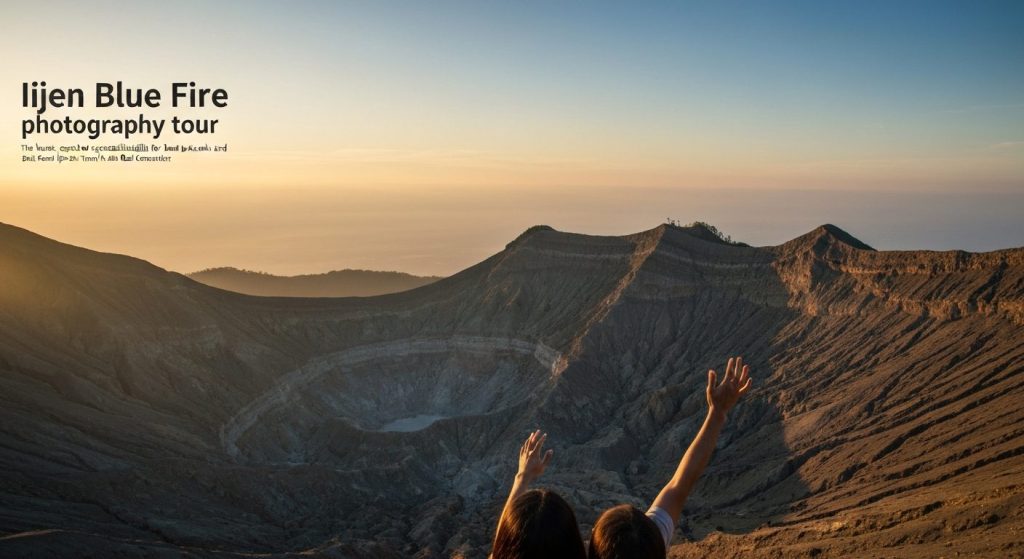
An ijen blue fire photography tour is a private, night-time Kawah Ijen trek planned around making images: the electric-blue flames, the miners at work, and the turquoise acid lake at first light. Instead of a rushed group walk, this is a craft-focused climb where we build the night around your shots, your tripod, and the narrow window before the blue fire fades.
As Ijen Trek & Volcano Editor at Ijen Blue Fire, I’ve done this 2am climb more times than I can sensibly admit. Below is exactly what this photography-focused itinerary involves, how it differs from a standard tour, and what you need to carry to come home with usable files instead of noise and blur.
Bali Premium Trip (founded 2015 in Kuta by Agung Afif) plans and sells this tour and arranges:
– Licensed Banyuwangi mountain guide
– Optional private photographer for Ijen blue fire
– Park entry and crater permits (when permitted to descend)
– Gas masks, headlamps, private car and ferry transfers from Bali
We do not own the mining concession or hold the park management permit ourselves. The rangers and current volcanic status always have the final word on access, descent, and closing the trail.
—
## What this Ijen blue fire photography tour actually is
This is a private Kawah Ijen night trek photography itinerary built around serious shooting time, not just “seeing” the flames.
Instead of joining a 20–30 person group that reaches the rim just as the blue fire is fading, we:
– Time your start so you hit the rim near the peak of blue fire visibility (typically 2.30–3.30am)
– Prioritise **key ijen blue fire photography spots and angles** on the rim and, when open, on the crater floor
– Build in static windows for long exposures instead of constant marching
– Optionally pair you with a **private photographer ijen blue fire** specialist who shoots alongside you and helps with settings and positioning
This tour is for:
– Photographers who know their way around manual mode and care more about a small number of strong frames than “checking off” an attraction
– Couples or small private groups who want freedom to pause, reframe, and repeat without pressure from a big group schedule
– Content creators chasing **ijen blue fire instagram worthy spots** but willing to hear the honest trade-offs between safety, reality, and what you’ve seen on social media
If you mainly want a simple hike and a quick phone shot, our standard blue-fire trek (without the dedicated photo pacing) is more efficient and cheaper.
—
## Key facts at a glance
- Tour focus
- Night long-exposure and composition time for blue fire, miners and crater lake, with optional private photographer
- Typical group size
- Private: usually 1–6 guests per Banyuwangi guide; 1:1 or 1:2 with optional photographer
- Hike distance & elevation
- ~3 km up to the rim with ~500 m elevation gain; plus up to ~1 km each way on the crater descent when open
- Highest point
- Rim around 2,350 m above sea level
- Departure from Bali
- Evening pickup (around 6–8pm) from south Bali or north coast, private car to Gilimanuk ferry and onward to Banyuwangi
- Indicative tour duration
- Door-to-door from south Bali: ~12–16 hours total; 4–5 hours of active hiking and shooting on the mountain
- Indicative cost range (last verified June 2026)
- From roughly US$130–220 per person from Banyuwangi, or US$190–320 per person from Bali for 2–4 guests; optional private photographer often adds US$100–250 per group
- Fitness level
- Moderate: you need to be able to walk steadily uphill on a 25–35% grade for 1.5–2 hours at night, with camera gear
- Safety gear
- Mandatory gas mask for all guests; headlamp, closed shoes; we strongly recommend trekking poles and a proper tripod
All prices are indicative only and vary by season, group size, and how much private support you add. Because Ijen Blue Fire is operated by Bali Premium Trip, you book directly with our own reservations team at transparent, published rates — with no third-party markup or hidden commission.
—
## What you actually see and shoot on this tour
### Electric-blue sulfur flames
The famous blue fire is not lava. It’s ignited sulfuric gases that burn bright cobalt on the dark crater floor.
Conditions allowing, the main compositions here include:
– **Wide, contextual shots** – 14–24mm lens, blue flames in the lower third, crater wall and stars or Milky Way above
– **Mid-telephoto frames** – 35–85mm, isolating arcs of flame and the reflective wet rock textures
– **Worker silhouettes** – miners walking through the gas plumes with baskets, shot against the glow
Important reality check:
– The flames **fade as dawn approaches**. By civil twilight there is usually no visible blue, just yellow/orange torches.
– On windy nights, gas moves fast; exposures longer than ~10–15 seconds turn the flames into soft clouds, which can be beautiful but different from the defined tongues many expect.
### Sulfur miners
Ijen’s workers carry baskets of solid sulfur, often 60–80 kg each, up from the crater floor to the rim. Their work is hard, hazardous and real.
Photographically:
– **Ethics first** – your guide will brief you on when and how to shoot. Some miners are comfortable being photographed, others are not. Ask or accept a shake of the head.
– **Low light** – much of this is lit only by miner lamps and your headlamp. You’ll be pushing high ISO, fast primes, and careful focusing.
– **Avoid flash in faces** – it’s blinding and dangerous on this terrain. If you must use artificial light, keep it low and diffuse, and never in a miner’s eyes.
### Turquoise acid lake at dawn
As night thins, the crater lake reveals itself: a milky turquoise pool of acidic water, steaming gently.
Typical frames:
– **Classic rim panorama** – 16–24mm; foreground ridge, lake, and smoking vents.
– **Compression of ridges** – 70–200mm; layering the crater walls with the lake surface.
– **Minimalist colour fields** – isolating the turquoise against dark rock.
Expect harsh contrast:
– The eastern rim blows out quickly as the sun rises. We’ll usually set you up before first light for cleaner exposures, then work graduated ND filters or bracketing as the dynamic range climbs.
—
## Route, timing and how the night unfolds
From a photographer’s perspective, timing is everything. Here’s the real schedule we work to most often.
### Typical departure from Bali
Exact timing depends on your pickup point, but for a **ijen blue fire photography tour from Bali** we usually aim for:
– **18.00–20.00** – Pickup from south Bali (Kuta, Seminyak, Canggu, Sanur) or Ubud. Drive to Gilimanuk port (~3.5–4.5 hours depending on traffic).
– **~22.00–23.00** – Ferry to Banyuwangi (crossing usually 45–60 minutes, plus port waiting time).
– **~23.30–00.30** – Private car up to the Ijen parking area / Paltuding post (~1–1.5 hours).
From north Bali locations (Pemuteran, Lovina) the road leg is shorter; your planner will adjust times.
### The night hike and photography windows
**00.30–01.00 – Gear check & park entrance**
– Final check of cameras, tripods, and gas masks.
– Last toilets, quick snack, layers on.
– Meet your Banyuwangi mountain guide and, if booked, your photographer.
**01.00–02.30 – Ascent to the rim (~3 km, 500 m gain)**
– The first 2 km are a consistent uphill slog. Not technical, but it bites.
– We keep a measured, photo-friendly pace. You’ll sweat, then chill quickly when we stop.
– There are short rest points every 20–30 minutes. This is not the time for elaborate tripod setups; save your energy for the crater.
**02.30–03.00 – Rim arrival and descent (when open)**
Here the plan branches depending on volcanic status and gas conditions:
– **If crater descent is allowed:**
– You’ll put your gas mask on and begin the steep, rocky drop into the crater.
– This section is narrow, with loose rocks and occasional traffic from miners. Tripod and camera go securely on your pack; no handheld shooting on the steeper parts.
– Allow 30–40 minutes down for a photo-focused, careful team.
– **If crater descent is closed:**
– We stay on the rim and work **ijen blue fire photography spots and angles** from above, where the flames are more distant but safer.
– Your guide will find you cleaner airflow lines to avoid standing in smoke.
**03.00–04.00 – Blue fire & miners (core shooting window)**
This is the most intense and gear-demanding hour.
We prioritise:
– A handful of stable long exposures of the blue flames
– Selected frames of miners at work, always with your safety and theirs in mind
– Keeping an eye on gas movement; sometimes we step back for 10–15 minutes to let a plume shift
We plan around the fact that:
– By 4.00–4.30am, the ambient light starts climbing. ISO requirements drop, but the flames lose definition quickly.
– The route back out is the same narrow path; we avoid leaving with the full crowd if possible so you can shoot without constant torch beams in frame.
**04.00–05.30 – Return to rim and lake photography**
– As we climb back to the rim (if descended), we use the height change for layering shots of miners on the path.
– On the rim we shift focus to **ijen turquoise crater lake photography** in the growing twilight.
– This is where a softer, more contemplative set often emerges – subtle colour gradients, silhouettes of hikers against the sky, and the scale of the crater.
**05.30–06.30 – Descent to Paltuding**
– Now it’s all downhill. Cameras usually stay in packs; the slope and early-morning fatigue make this a trip-hazard section.
– Average descent time: 60–90 minutes depending on knees, shoes, and how much gear you’re carrying.
**06.30–08.30 – Local breakfast & return**
– We typically stop at a simple local warung or homestay for breakfast. Coffee here tastes especially good after a sulfur night.
– Private car back to your Banyuwangi stay or onward ferry to Bali. For Bali returns, expect to reach south Bali early- to mid-afternoon.
All times are approximate. Park authorities may shift gates, and your guide will always adapt to current conditions.
—
## How this differs from a standard blue-fire group tour
You will see many offers marketed as “photography-friendly”, yet on the trail they march like any other group. Here’s the honest comparison.
| Feature | Dedicated photography tour (this) | Typical open group tour |
|---|---|---|
| Group size | Private: usually 1–6 guests | Often 10–25 guests per guide |
| Primary goal | Time and positioning for long exposures and composition | Quick view of blue fire and crater, phone snapshots |
| Pace | Adjusted to photographers, with planned static shooting blocks | Set pace to keep group together; limited time in any one spot |
| Crater descent (when open) | Guide chooses spots based on wind and background, not just shortest path | Single path in/out; more crowding at obvious viewpoints |
| Support with settings | Guide + optional photographer share concrete ISO/shutter/aperture choices | General advice only, usually focused on safety and schedule |
| Cost | Higher per person; you’re paying for private time and expertise | Lower per person due to group sharing |
| Chance for “clean” frames | Better: fewer headlamps in frame, easier to adjust position | More chances of other hikers/torches in your long exposures |
Choosing the photography tour is not “better” by default. It’s better **if** your priority is image-making over simple sightseeing, and you’re okay with paying more and carrying heavier gear for that goal.
—
## Recommended camera gear for Ijen
You do not need every toy in the catalogue. You do need reliable basics that you can operate at 2.30am on a steep trail while short of sleep.
### Camera bodies
– **Interchangeable-lens camera preferred** – mirrorless or DSLR with good high-ISO performance. Full-frame helps, but a modern APS-C body can absolutely deliver.
– **Dual-slot bodies** are a comfort, but not mandatory. More important is familiarity; bring the camera you know in the dark.
Spare batteries are non-negotiable. The cold, long exposures and constant live-view drain them faster than daytime shooting. Pack at least 2–3 fully charged spares per body.
### Lenses
For a dedicated **ijen blue fire photography tour**, we typically see the best results with:
– **Wide / ultra-wide (14–24mm)**
– Essential for showing the crater context, stars (if clear), and large blue-fire scenes.
– **Standard fast prime (24mm, 35mm or 50mm at f/1.4–f/2)**
– Useful for miner portraits and low-light scenes where you want to keep ISO under some control.
– **Short telephoto (70–200mm)** (optional but helpful)
– For compressing layers on the crater walls and isolating miners from a safer distance.
If you want to keep it simple: one wide zoom (e.g. 16–35mm) plus one fast prime covers 90% of what you’ll likely shoot.
### Support & accessories
– **Tripod:** Stable, not ultralight toy-level. You’ll be shooting 5–20 second exposures in wind. A mid-range aluminium or carbon tripod that hits ~1.4–1.6 m without center column is ideal.
– **Headlamp:** White light with a **red mode**. Red preserves your night vision and is kinder to others’ frames.
– **Remote shutter / intervalometer:** Helpful but body-based 2-second timer works in a pinch.
– **Lens cleaning kit:** Microfiber cloth and blower. Sulfur particles and condensation are guaranteed guests.
– **Protective covers:** Simple rain cover or plastic for sudden drizzle or heavy gas condensation on gear.
– **Spare cards:** Treat them as cheap insurance.
You can shoot with a phone, but you will be fighting noise, focus hunting and dynamic range. This tour is designed around “real camera” expectations.
—
## Suggested camera settings and techniques
These are **starting points**, not magic formulas. Conditions shift with moonlight, cloud, and wind, but they will get you in the usable zone quickly.
### Best camera settings for Ijen blue fire
For wide blue-fire scenes on the crater floor or rim:
– Mode: **Manual**
– Aperture: **f/2.8–f/4** (wider if your lens allows and depth-of-field permits)
– Shutter speed: **5–15 seconds**
– ISO: **1600–6400** depending on moon and ambient light
– Focus: Manual focus, pre-set on a high-contrast edge lit by your headlamp, then tape or leave it alone
Watch your histogram:
– If you clip highlights, shorten shutter speed or drop ISO.
– If you’re buried hard left (underexposed black frame), lift ISO first before stretching shutter too long and turning flames into smears.
For tighter shots of flames:
– You may want **shorter shutters (1–4 seconds)** to retain shape in the gas tongues.
– Compensation is via higher ISO; embrace some noise and plan to clean it in post.
### Miners and motion
Miners move fast enough that 10–20 second shutters will render them as ghosts.
For defined figures:
– Aperture: **f/1.4–f/2.8** (the faster, the better, watch your focus plane)
– Shutter: **1/40–1/160 sec** depending on movement and stabilisation
– ISO: **6400–12800 or higher** on modern bodies
Accept grain. It’s part of the story here. Slight motion blur in limbs can convey movement if you freeze the head and basket.
### Ijen crater long exposure night photography tips
– **Take test frames at ISO 12800** – 1–2 second test shots to nail composition and focus quickly, then drop ISO and lengthen shutter for the final file.
– **Bracket exposure for the lake** at dawn – one for the sky, one for the lake, one for the rock. You can blend later.
– **Use your tripod as a safety anchor** – planted wide and low, not tall and wobbly, especially on the crater path.
– **Turn off in-body and lens stabilisation** when on tripod to avoid micro-blur.
– **Disable long exposure NR** if it doubles your waiting time between shots; you’ll miss evolving gas patterns. Instead plan to run NR in post.
Your guide and optional photographer will help you translate these numbers to the actual night in front of you.
—
## Safety: gas masks, trail reality and what we won’t promise
Kawah Ijen is a working sulfur mine inside an active volcanic complex. It is not a night street shoot.
### Gas and masks
– The blue fire is literally burning sulfur gases. These include **SO₂** and other compounds that can irritate or damage lungs and eyes.
– A proper **cartridge gas mask** is not a photo prop; it is essential kit. We arrange masks for all guests and check fit at the base.
– Cloth masks, buffs and simple hospital masks are inadequate here.
If the gas blows hard and low:
– Your guide may pull you back, upwind, or higher on the crater wall.
– This might cost you a frame you wanted. It protects your lungs and eyes. That’s a trade-off we will always choose.
### Trail and fitness
– The main track is a wide volcanic path, but it is **steep** and sustained. Expect to breathe hard.
– The crater descent (when open) includes sections of loose rock and broken steps. In the dark. With others coming both ways.
You should skip this tour or stay on the rim if:
– You have significant heart or lung issues not cleared by a doctor.
– You have severe vertigo or balance problems.
– You are not comfortable walking down loose, uneven terrain with minimal artificial light.
Your guide always has authority to stop, turn around, or keep you on the rim if they judge the conditions or your state unsafe.
### Closures and guarantees
We cannot guarantee:
– Access to the crater floor on any given night
– Clear views of the blue fire (smoke can obscure it entirely)
– Cloud-free sunrise or visible stars
– Particular shots (e.g., miner posing in a specific place)
Park authorities may close the entire trail or just the crater descent at short notice due to:
– Elevated volcanic activity
– Heavy gas and wind direction
– Heavy rain, landslides, or other safety concerns
If that happens, we pivot to the best lawful vantage points. Sometimes that means more creative rim work and texture studies instead of classic crater-floor frames.
—
## Ijen blue fire photography tour cost and what’s included
All numbers here are **indicative ranges**, last verified June 2026. They are not fixed quotes and vary by time of year, group size, and how much custom support you add.
### From Banyuwangi area (you get yourself to East Java)
For guests already staying in Banyuwangi or nearby:
– **Indicative range:** roughly **US$130–220 per person** for 2–4 guests on a private basis
– Solo travellers often pay more per person; larger private groups may pay slightly less.
Typically includes:
– Private car transfers between your Banyuwangi stay and Ijen base
– Licensed Banyuwangi mountain guide
– Gas masks and headlamps
– Park entry and standard permits
– Basic snacks / simple breakfast (varies by provider)
Optional extras that add to cost:
– Private Ijen-savvy photographer joining your group
– Upgraded breakfast or additional stops in the area
– Extra porters if you want help carrying your camera bag
### Ijen blue fire photography tour from Bali
Door-to-door from Bali (south or north), your day is longer and logistics are heavier: extra drivers, ferry tickets, and time.
Indicative range for a private photography-focused itinerary:
– Around **US$190–320 per person** for 2–4 guests
– Again, solo or 1-on-1 setups cost more; larger families or groups may spread costs more efficiently.
Typically includes:
– Private car in Bali (pickup and drop-off from your accommodation)
– Bali–Java–Bali ferry tickets
– Private car in Banyuwangi to/from Ijen
– Licensed mountain guide
– Gas masks, headlamps
– Park entry and related permits
– Simple meals (late-night snack, breakfast or box meals – varies by current partner)
### Private photographer option
Adding a dedicated **private photographer ijen blue fire** usually increases the total trip by roughly:
– **US$100–250 per group**, depending on experience level, what deliverables you want (raws vs edited images), and whether they travel from Bali or are Banyuwangi-based.
Trade-off: paying for a photographer means less pressure on your own shooting, but also more bodies in tight spaces and possibly a slower pace if you’re all setting up similar frames.
Bali Premium Trip does not own the guiding companies or photography studios we work with. We curate and arrange based on long-term relationships and trail experience. Because Ijen Blue Fire is operated by Bali Premium Trip, you book directly with our own reservations team at transparent, published rates — with no third-party markup or hidden commission.
To get a tailored cost for your dates, group size and gear priorities, you can plan your trip with us by email or WhatsApp; we’ll lay out options side by side so you can see the trade-offs clearly.
—
## Is this photography tour right for you?
Say yes to this version of Kawah Ijen if:
– You’re comfortable walking uphill for 1.5–2 hours in the dark at 2,000+ m altitude.
– You’re willing to carry a tripod, a real camera, and at least one spare lens on steep ground.
– You understand that some nights yield once-in-a-decade frames and others yield mostly “solid documentation”, and you’re okay with that uncertainty.
– You care about working respectfully around miners and are ready to put safety over that “perfect shot”.
Consider the standard trek instead if:
– You mainly want a memorable experience and a few phone or compact-camera shots.
– Budget is tight and you’d rather join a small group than pay for private pacing.
– You’re unsure about spending most of a night awake and active.
If you’re somewhere in between, we can also hybridise: a slightly more photography-aware standard tour with a smaller group, but not the full private-build photography itinerary. Just tell us how important the images are relative to comfort and cost when you plan your trip; WhatsApp works well for this back-and-forth.
—
## FAQs
How hard is the Kawah Ijen night trek for photographers carrying gear?
The trail is short but steep: about 3 km up with 500 m vertical gain to the rim, plus an optional 1 km each way into the crater when open. With camera gear and a tripod it feels like a solid workout, not a casual walk. Most reasonably fit people manage it with rests. If you rarely hike and are carrying a heavy pack, expect to stop often and sweat on the way up.
Can I always go down to the crater floor to photograph the blue fire up close?
No. Crater descent is controlled by park authorities and depends on current volcanic activity, gas levels, and weather. On some nights only rim access is allowed. Your guide must follow the rules on the ground; if the crater is closed we focus on blue fire and lake compositions from safer rim positions instead.
Is a gas mask really necessary for the Ijen blue fire area?
Yes. The blue fire is burning sulfur gas, which produces SO₂ and other irritants that can cause strong coughing, breathing difficulty, and eye irritation. A proper cartridge gas mask is essential when moving near the vents or standing in shifting plumes. We arrange masks for all guests and your guide will explain when to wear them and when it’s safe to remove them.
What if I only have a smartphone – is the photography tour still worth it?
You can still enjoy the night and capture memories on a phone, but this specific photography-focused tour is designed around cameras that handle manual settings, tripods, and higher ISO performance. If you only plan to shoot with a smartphone, a standard blue-fire trek with a smaller private group is usually a better value and more aligned with your needs.
Can the private photographer guarantee specific shots or an exact number of images?
No. Conditions at Ijen are unpredictable: gas can obscure the flames, the crater might be closed, and weather can shut down certain angles. A private photographer increases your chances of strong images by helping with timing, settings, and positioning, but they cannot control the environment. They will typically agree on an approximate number or style of deliverables, but not on exact scenes or moments.